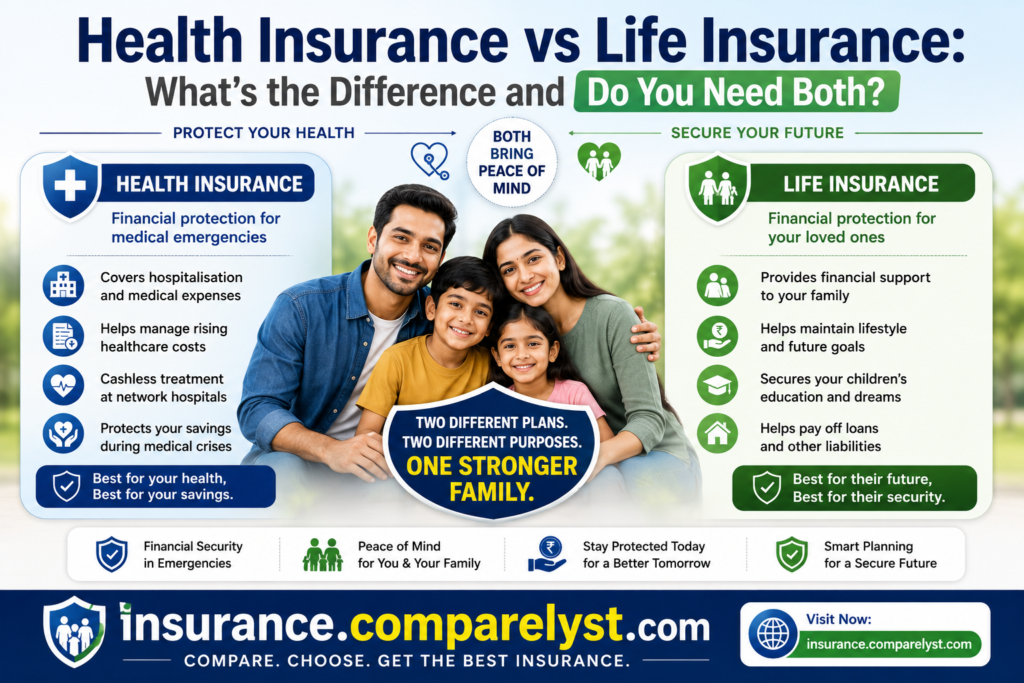
Health Insurance vs. Life Insurance: What’s the Difference and Do You Need Both?
“People say health insurance and life insurance are different things. But what is the actual difference between the two? Is having just health insurance enough for me? What is the purpose of life insurance? Is my family truly secure only if I take out both policies?”
I had similar questions when I first started learning about insurance. Especially when searching online, you come across terms like health insurance, term insurance, life insurance, family floater, sum insured, and life cover. They all seem alike. However, in reality, health insurance and life insurance are financial protection products serving completely different purposes.
To put it simply: health insurance is protection that helps manage eligible medical expenses incurred when you undergo hospital treatment for health issues. Life insurance is protection that ensures financial support reaches the policyholder’s dependent family in the event of the policyholder’s death, subject to the policy terms.
Once you understand this difference, answering the question “Do I need both?” becomes very easy.
In this article, we will look at—in very simple terms—how health insurance and life insurance work, the differences between them, who needs what, when it is useful to hold both policies, how much coverage to consider, and what to look for when buying a policy.
First, what is health insurance?
To understand health insurance simply, it is insurance that provides financial protection against medical expenses.
Let’s assume you have a health insurance policy with a sum insured of ₹10 lakh. A few days later, you unexpectedly require hospitalization. The total cost—including treatment, hospital charges, doctor fees, medicines, and other expenses eligible under the policy—comes to ₹3 lakh.
In that situation, the insurance company can settle the claim, subject to the policy’s terms and conditions.
However, there is an important point to note here. You shouldn’t assume, “I have ₹10 lakh worth of health insurance, so the company will pay the entire hospital bill regardless of the amount.” A policy may include exclusions, waiting periods, co-payments, deductibles, room-rent limits, and other conditions; therefore, the actual claim amount varies depending on the policy terms.
IRDAI’s guidelines for policyholders also emphasize the importance of understanding policy terms, restrictions, and benefits before purchasing insurance.
So, what is the primary function of health insurance?
It helps alleviate the financial burden that arises when you or a family member requires medical treatment.
In that case, what is Life Insurance?
Life insurance serves a different purpose.
Let us understand this through a family scenario.
Suppose a family member earns ₹70,000 per month. This income covers household expenses, children’s education, home loan EMIs, and other financial responsibilities.
What happens if that person passes away unexpectedly?
The issue here goes beyond just medical bills; the family loses its regular source of income.
Life insurance helps manage this type of financial risk.
A life insurance policy provides life cover to the policyholder. Subject to the policy terms and conditions, if the insured person passes away, the nominee may receive a death benefit.
Term insurance is a specific type of life insurance. The primary objective of pure term insurance is not investment returns, but rather providing life cover for a specific policy term.
Therefore, health insurance and life insurance should not be viewed as belonging to the same category.
- Health Insurance → Protection against medical expenses
- Life Insurance → Financial protection for the family after death
Understanding these two points clarifies the basic difference between them.
What is the major difference between Health Insurance and Life Insurance?
Let’s consider a practical example.
Suppose you are 35 years old. You have a spouse and two children.
You hold a health insurance policy with a coverage of ₹10 lakh.
One day, a situation arises where you need hospital treatment. Subject to the policy’s coverage and conditions, health insurance can help cover eligible hospital expenses.
However, consider a different scenario.
If you were no longer around, health insurance would not replace your monthly salary for your family.
That is where life insurance becomes crucial.
If you have adequate life cover, the nominee can receive a death benefit subject to the policy terms. This amount can help manage the family’s immediate and future financial responsibilities.
Thus, the two policies serve different purposes.
Health insurance aims to protect you from medical expenses. Life insurance aims to protect your family from the financial impact of income loss.
Is Life Insurance unnecessary if you have Health Insurance?
No.
This is a common misconception many people have.
Thinking, “I have health insurance, so I have insurance protection,” does not represent the full picture.
Health insurance may provide financial protection for medical treatment expenses, but it is not a life cover that replaces your future income for your family.
For instance, suppose you have health insurance worth ₹10 lakh.
It is useful if you undergo hospital treatment.
However, if you are no longer around and your spouse faces household expenses, children’s education costs, a home loan, and other financial responsibilities for the next 10 or 15 years, health insurance will not address that income gap.
That is why one must consider life insurance separately when there are family members financially dependent on them.
Is Health Insurance unnecessary if you have Life Insurance?
No, that is not the case either.
Thinking, “I have ₹1 crore term insurance, so I don’t need health insurance,” is also a mistake.
Suppose you have ₹1 crore term insurance. You are alive, but you require major medical treatment. Term insurance is not a product designed to pay your hospital bills.
Health insurance is the relevant product for managing medical expenses.
Therefore, when considering financial protection for a family, one must view two distinct risks separately.
“What happens if I get admitted to the hospital?”
Health insurance addresses this.
“How will my family manage if I am no longer around?”
Life insurance addresses this.
There is no single answer that covers both questions.
Who Needs Health Insurance?
Health insurance can be useful for almost every family. However, given the rising cost of medical care, it has become a particularly crucial form of financial protection.
Younger individuals might be tempted to ignore health insurance, thinking, “I don’t have any health problems right now.”
However, insurance is not a product to be purchased only after a problem arises.
Creating financial protection for future medical expenses while you are still relatively healthy is a practical approach.
If you have a spouse, children, or parents in your family, medical expenses can impact the family’s overall finances, not just the individual’s.
Therefore, instead of viewing health insurance as an unnecessary expense, consider it an essential part of emergency financial planning.
Who Needs Life Insurance?
The importance of life insurance is generally greater when you have financial dependents.
If your spouse, children, or parents rely on your income, they would need financial support in the event that your income ceases.
Similarly, if you have a large home loan or other financial liabilities, these should also be factored into the calculation of your life insurance coverage.
For instance, the life insurance needs of a single person with no dependents or major financial liabilities would differ from those of a married person.
Therefore, the idea that “everyone should take a ₹1 crore term insurance policy” is not necessarily the right approach.
You must first assess whether you need coverage based on your family responsibilities.
What Are the Benefits of Having Both?
Having both allows you to address two distinct financial risks.
Let’s look at an example.
Consider a person named Ramesh. He has a wife and a child, and he has a home loan. He earns ₹80,000 per month.
He holds a health insurance policy.
Now, suppose he requires major surgery.
In this situation, the health insurance policy can help cover eligible medical expenses, subject to the policy terms.
Now, let’s also assume that Ramesh holds a suitable term life insurance policy for his family.
If he were to pass away unexpectedly, the nominee would receive the life insurance death benefit, subject to the policy terms. So, one policy addresses the risk of medical expenses, while the other addresses the risk of income loss.
This is the fundamental advantage of holding both.
How much health insurance coverage do you need?
There is no single answer that applies to everyone.
The required health insurance coverage can vary based on factors such as your age, family size, location, medical costs, existing employer coverage, and financial situation.
For instance, the coverage required by a family living in a metropolitan city—where living expenses and hospital costs are higher—may differ from that of a family in a different location.
It is also important to consider whether you are including your parents in the policy.
Beyond just the coverage amount, you should examine policy conditions such as room rent limits, co-payment, waiting periods, exclusions, and network hospitals.
A policy does not automatically become the best one simply because it offers a large sum insured.
How much life insurance coverage do you need?
This involves a somewhat personal calculation.
You should consider factors such as your annual income, outstanding loans, your children’s future expenses, family living expenses, your spouse’s income, and your savings and investments.
For example, let’s say your annual income is ₹8 lakh.
You have an outstanding home loan of ₹40 lakh.
You might need ₹30 lakh for your children’s future education and other major goals.
Your family might require income replacement and a financial cushion.
At the same time, you have ₹20 lakh in savings and investments.
You can estimate your life cover requirement by taking all these factors into account.
While “taking 10 times your salary” can serve as a starting point, it is not a universal formula.
What truly matters is the amount of financial support your family would actually need.
Do you need separate health insurance if you have employer-provided insurance?
This is a very practical question.
Many companies provide group health insurance to their employees.
Consequently, some people might think, “I have company insurance, so I don’t need separate health insurance.”
However, you need to understand the coverage amount, conditions, and the implications regarding your employment status under the employer’s group policy.
Whether the employer-provided coverage continues if you change jobs or leave the company depends on the specific policy arrangement.
Therefore, even if you have employer health insurance, it is useful to review whether your personal financial situation requires a separate health insurance policy.
Do you need term insurance if you have employer-provided life insurance?
The same logic applies here.
Some companies provide group life insurance or employer-provided life cover to their employees.
However, you must assess whether that coverage is sufficient to meet your family’s long-term needs.
Suppose a company provides a cover of ₹20 lakh. If your financial calculations indicate that your family needs protection worth ₹1 crore, the employer’s cover alone might not be enough.
Furthermore, you need to check the policy terms to see if the coverage continues if you change jobs.
Thus, while employer insurance can be viewed as an additional benefit, you should not confuse it with your personal insurance requirements.
Why is the Waiting Period Important in Health Insurance?
When purchasing health insurance, you should consider not only “how much coverage” you get but also “when the coverage begins.”
Waiting periods may apply to certain pre-existing diseases and specified treatments.
For instance, if you already have a specific health condition, the policy might impose a waiting period for that condition.
Therefore, it is crucial to review the details regarding waiting periods before purchasing the policy.
Additionally, you must accurately disclose your existing medical history in the proposal form.
IRDAI’s resources for policyholders also highlight the importance of understanding policy details and conditions before buying insurance.
Why is Medical Disclosure Important in Life Insurance?
A life insurance application may ask for details regarding your health condition, medical history, and lifestyle.
Withholding information—thinking it is a “minor detail” not worth mentioning—is not a good idea.
Providing accurate information in the proposal form helps avoid unnecessary complications during the future claims process.
Rather than hiding information just to secure a lower premium, it is a safer approach to provide accurate details and purchase the policy with a clear understanding of its terms.
IRDAI’s consumer education materials also emphasize the importance of filling out the proposal form with accurate and complete information.
Why Do Premiums Differ Between the Two Types of Insurance?
Health insurance premiums and life insurance premiums cannot be directly compared.
Health insurance premiums can be influenced by factors such as age, coverage amount, medical profile, family members included, and the policy structure.
For life insurance premiums, key factors include age, sum assured, policy term, health profile, lifestyle, and underwriting criteria.
Therefore, it is not meaningful to compare them by simply saying, “My health insurance premium is ₹15,000 and my life insurance premium is ₹10,000, so life insurance is cheaper.”
Each provides protection against different financial risks.
Don’t focus solely on low premiums when buying insurance.
This advice applies to both types of insurance.
Just because a health insurance policy has a low premium, it doesn’t mean it is the best option.
Similarly, a term insurance policy with a low premium isn’t automatically the most suitable choice.
- What is the coverage?
- What are the exclusions?
- Is there a waiting period?
- What is the policy term?
- What are the claim conditions?
- Is there a co-payment or deductible?
- What is the network of hospitals like?
Comparing premiums is meaningful only after you have answers to these questions.
IRDAI’s consumer education resources also advise fully understanding policy details, comparing similar plans, and being aware of product features and charges before purchasing.
Should you buy both health insurance and life insurance from the same company?
Not necessarily.
Health insurance and life insurance are two different products; there is no rule stating they must be purchased from the same insurer.
You might consider a health insurance product if it offers good coverage and favorable terms.
Separately, you could consider a life insurance product that aligns with your family’s protection needs.
The company name isn’t the only important factor; what matters is whether the product terms align with your requirements.
Do married individuals need both?
Both types of insurance can be useful for many married individuals.
This is often due to significant family responsibilities.
If you have a spouse, children, a home loan, household expenses, or educational goals, life insurance can serve as a financial safety net.
At the same time, health insurance can help ensure that a medical emergency does not deplete the family’s savings.
However, the exact coverage amount and policy type will vary for each family.
Do single individuals need both?
Being single doesn’t mean you don’t need health insurance.
A health emergency can happen to anyone, making health insurance independently useful.
The need for life insurance, however, depends on financial dependents and liabilities.
For instance, if your parents rely on your income, life cover might be necessary.
Similarly, if you have a large loan or other financial responsibilities, you might want to consider life insurance. How should you look at insurance for your parents?
It is best to address your parents’ insurance needs separately.
Health insurance premiums and policy conditions can differ significantly due to their age.
You need to pay close attention to factors such as pre-existing conditions, waiting periods, co-payments, exclusions, and network hospitals.
Do not simply assume that a “family policy” covers your parents; check the actual policy terms.
Insurance is not an investment.
This is a crucial concept to remember when discussing these two types of products.
The primary purpose of health insurance is to provide financial protection against medical expenses.
The primary purpose of pure term insurance is to provide life cover.
Therefore, you should not evaluate insurance solely based on the financial returns it might yield.
First, you must understand the specific risks it protects against.
Insurance is a tool for managing unexpected financial loss.
Do I need both? A simple answer.
It depends on your situation.
If you are the person financially responsible for your family, both health insurance and life insurance are likely to be beneficial.
Health insurance helps provide financial protection against medical expenses.
Life insurance—specifically term insurance—provides financial support to your family in your absence.
However, decisions regarding the specific policy, coverage amount, and policy term should be based on your income, family responsibilities, health profile, loans, savings, and future goals.
A Simple Family Example
Let us look at this through the example of a family.
Aravind is 34 years old. He earns ₹75,000 per month. His wife works part-time. They have a 5-year-old child and a home loan of ₹35 lakh.
He does not have health insurance.
He does not have life insurance either.
What should he do first?
He needs to consider health insurance to ensure that his savings remain intact in the event of a medical emergency.
At the same time, he needs to consider suitable life cover by thinking about how the family income would continue if he were no longer around.
Factors such as the home loan, child’s education, household expenses, existing savings, and his spouse’s income can be considered when calculating the required life cover.
Here, the two insurance policies do not solve the same problem.
One addresses the risk of medical expenses.
The other addresses the risk of income loss.
Therefore, both must be considered separately.
Finally, here is my opinion:
When comparing Health Insurance and Life Insurance, asking “Which is better?” is somewhat incorrect.
This is because they serve different purposes.
Health insurance is relevant if you require hospitalization.
Life insurance is relevant if your family depends on you financially and you are no longer around.
Therefore, it is wrong to say, “If I have health insurance, I don’t need life insurance.”
It is also wrong to say, “If I have life insurance, I don’t need health insurance.”
In a family’s financial planning, both policies address two distinct risks.
If I were to state just one thing about insurance, it would be this: understand the purpose of the policy before buying it.
Do not choose a policy solely because the premium is low. Read about the coverage amount, exclusions, waiting periods, policy term, claim-related conditions, and other important terms.
Accurately disclose your medical history and other relevant information.
Review your insurance coverage whenever your financial responsibilities change.
Importantly, just because someone else has taken a ₹1 crore term insurance policy, there is no need for you to take the same amount. Similarly, just because someone holds a ₹5 lakh health insurance policy, you cannot assume that the same coverage is sufficient for you. Insurance is not a financial product to be chosen simply by copying others. It should provide protection tailored to your life, family, income, and responsibilities.
Health insurance can serve as a financial safety net for your medical expenses.
Life insurance can act as a safety net ensuring your family’s future financial security.
By properly understanding both and selecting coverage suited to your needs, you can better manage the financial pressure arising from unexpected situations.
Important Note
This article is written solely for general educational and informational purposes. Details regarding eligibility, premiums, coverage, exclusions, waiting periods, benefits, claim conditions, and other terms for health and life insurance products may vary depending on the insurer and the specific product. Before purchasing any policy, please carefully read documents such as the policy wording, Customer Information Sheet, and benefit illustration provided by the insurer. It is advisable to seek any necessary clarifications from the authorized insurer or a licensed insurance intermediary.
This does not constitute personal financial, medical, or insurance advice. You may wish to consult a qualified professional to determine the insurance coverage best suited to your personal financial situation.
Health Insurance vs Life Insurance – FAQ
1. What is Health Insurance?
Health Insurance is an insurance policy that provides financial protection against expenses related to hospitalization or eligible medical treatments specified in the policy. You can claim for medical expenses subject to the policy terms and conditions.
2. What is Life Insurance?
Life Insurance is an insurance that provides financial benefits to the nominee or eligible beneficiary in the event of the death of the policyholder. In particular, the main purpose of Term Insurance is to provide financial protection to the family.
3. What is the difference between Health Insurance and Life Insurance?
The purpose of the two is different. Health Insurance helps in managing medical expenses; Life Insurance helps in providing financial protection to the family in the absence of the policyholder.
4. Is Life Insurance necessary if you have Health Insurance?
That is not true. Health Insurance can provide protection for your medical expenses. But it does not replace the income loss incurred by the family after the death of the policyholder. If you have family financial dependents, it is better to consider the need for Life Insurance separately.
5. Do I need health insurance if I have life insurance?
No. Term life insurance is not designed to pay hospital bills. Health insurance can be useful for financial protection in case of medical emergencies.
6. Do I need two insurance policies?
It depends on your financial situation. Life insurance can be useful if family members depend on you financially. At the same time, health insurance can be useful to manage unexpected medical expenses. For many families, it is practical to have two types of protection separately.
7. How much coverage should I take in health insurance?
There is no one answer for everyone. You can choose coverage by considering your age, family size, location, medical costs, existing employer coverage and financial situation. You should also look at the policy conditions, not just the sum insured.
8. How much life cover do I need in life insurance?
You can estimate the required life cover by considering annual income, outstanding loans, children’s future education expenses, family living expenses, existing savings and investments, and spouse’s income. It is better to decide based on your family requirements rather than copying the coverage taken by others.
9. Do I need separate health insurance if I have employer health insurance?
Group health insurance provided by an employer can be useful. But you should check the details like its coverage, exclusions, waiting periods, and whether the coverage continues after employment ends. It is better to review whether separate health insurance is required according to your needs.
10. Do I need term insurance if I have employer life insurance?
You should check whether the life cover provided by the employer is sufficient for your complete family financial requirement. You should also check in the policy terms whether the coverage will continue when your employment changes.
11. What is the waiting period in health insurance?
Waiting Period is the period when coverage is not available immediately after the policy is started for a specific disease, treatment or pre-existing condition, but coverage is available after a certain period.
12. What happens if there is a Pre-existing Disease in Health Insurance?
Even if there is an existing medical condition, there may be insurance options. But there may be a waiting period, exclusions or other policy conditions for that condition. It is very important to disclose medical history truthfully in the proposal form.
13. Who is a Nominee in Term Insurance?
A nominee is the person mentioned in the policy to receive the death benefit in the event of the policyholder’s death, subject to the policy terms. It is a good idea to provide the nominee details correctly and review them if there are significant changes in your life.
14. Should you buy both Health Insurance and Life Insurance from the same insurance company?
Not necessarily. The purpose of the two products is different. There is generally no restriction on choosing one insurer for Health Insurance and another insurer for Life Insurance. It is important to compare the policy terms and coverage that suit your needs.
15. Is it enough to look at the premium alone when buying insurance?
Not enough. Instead of comparing premium alone, you should also look at coverage, exclusions, waiting periods, policy term, co-payment, deductibles, claim-related conditions and other important terms.
16. Should you buy insurance at a young age?
Age alone does not determine the need for insurance. But long-term planning can be useful for some people when they have fewer financial responsibilities at a young age. You can decide based on your income, dependents, health and financial goals.