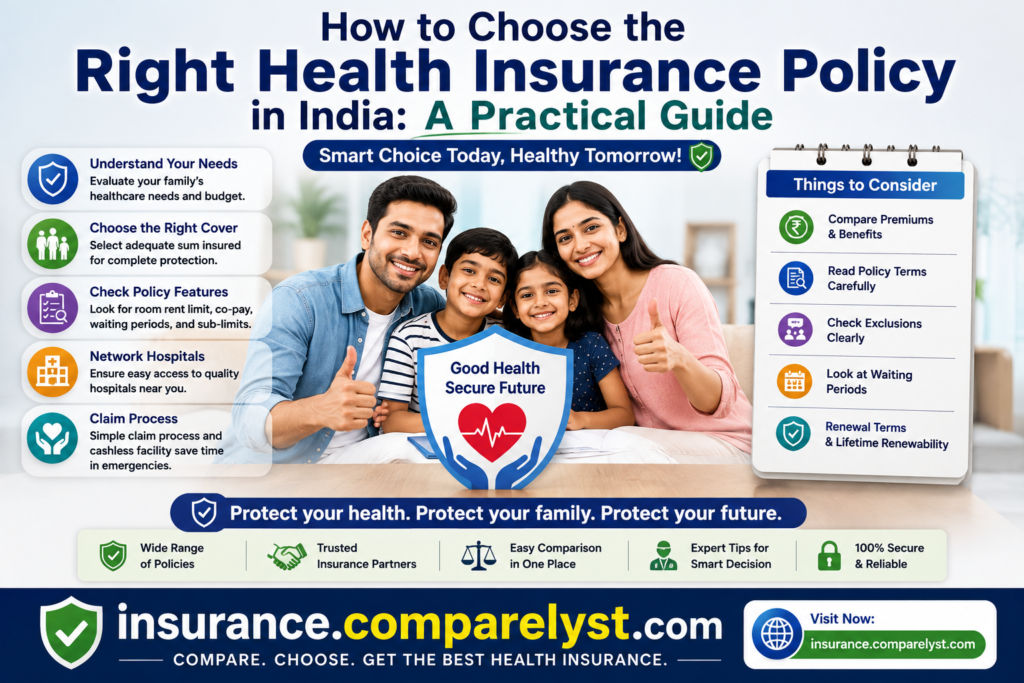
How to Choose the Right Health Insurance Policy in India: A Practical Guide
“I’ve decided to buy health insurance. But which policy should I choose? Is ₹5 lakh enough, or should I opt for ₹10 lakh? Is a family floater better, or an individual policy? Is it enough to just pick a policy with a low premium?”
Questions like these can be confusing. This is especially true for first-time buyers, as the multitude of options on insurance websites can be overwhelming. Even a single company offers various plans, each with different terms regarding coverage, waiting periods, room-rent conditions, co-payments, and exclusions.
When I first started learning about health insurance, I also thought, “High coverage is enough, and a low premium is a bonus.” However, a closer look at the policy details reveals that choosing health insurance isn’t just about the premium and the coverage amount.
In reality, a good health insurance policy is one that aligns with your lifestyle, family size, medical needs, budget, and future requirements.
In this guide, we will simply explore what to look for when buying health insurance in India: how much coverage to consider, the difference between individual policies and family floaters, the concept of cashless hospitalization, the importance of waiting periods, how room-rent limits and co-payments affect your claims, and the key questions to ask before purchasing a policy.
First, Understand Why Health Insurance is Necessary
Before asking “How much coverage do I need?” when buying health insurance, it is better to first ask, “What am I getting covered for?”
In the event of a medical emergency, hospital expenses can rapidly deplete your savings. Costs associated with surgeries, hospitalization, diagnostic tests, medicines, and other eligible medical expenses can quickly add up to a hefty bill.
At such times, a health insurance policy can help manage these eligible expenses, subject to the policy’s terms and conditions.
This is the fundamental purpose of health insurance.
Therefore, it is practical to view health insurance not as an investment, but as financial protection against unexpected medical expenses. IRDAI advises policyholders to carefully read the terms and conditions when purchasing health insurance, disclose any pre-existing health conditions, and pay attention to details such as room rent/ICU limits, waiting periods, exclusions, co-payment clauses, and network hospitals.
“How much health insurance coverage do I need?”
This is usually the first question that arises.
Is ₹5 lakh enough? Is ₹10 lakh a good amount? Should I opt for ₹20 lakh?
There is no single answer that applies to everyone.
You need to consider factors such as your age, family size, location, existing medical conditions, lifestyle, income, savings, and medical expenses.
For instance, the coverage required by a 25-year-old single person differs from that needed by a 40-year-old married person with a spouse and two children.
Whether or not you include your parents in the policy is also a crucial factor.
While ₹5 lakh might seem sufficient for a family initially, that same coverage could prove inadequate a few years later as medical expenses rise.
Therefore, it is wise to consider future healthcare costs rather than focusing solely on current expenses.
Is a low premium the only sign of a good policy?
No.
This is a crucial point to remember when purchasing health insurance.
Consider two policies: one with an annual premium of ₹8,000 and another with ₹12,000.
You should not immediately conclude that the ₹8,000 policy is better simply because it costs less.
The ₹8,000 policy might have a room-rent limit, a longer waiting period, a co-payment clause, or sub-limits for specific treatments.
The conditions in the ₹12,000 policy might differ.
Therefore, rather than comparing premiums alone, the key question is: “What protection do I get for this premium?”
Sometimes, paying a slightly higher premium can be the practical choice if it provides coverage and conditions that best suit your needs.
What is Individual Health Insurance?
Individual health insurance is a policy that typically provides a specific sum insured for a single insured person.
For instance, if you purchase an individual health insurance policy with a sum insured of ₹10 lakhs, that amount is dedicated to your medical needs.
This can be a straightforward option for a single individual.
If each of your family members has a separate health insurance policy, each person will have their own distinct sum insured.
However, if there are multiple family members, the total premium for individual policies could be quite high.
So, let us look at the next option.
What is Family Floater Health Insurance?
A family floater policy features a common sum insured that can be utilized by all the family members included in the policy.
For example, imagine a family floater policy with a sum insured of ₹10 lakhs covering a husband, wife, and children.
If the husband incurs treatment expenses of ₹3 lakhs in a year, the eligible claim amount can be drawn from that common sum insured. The remaining balance may be available for other family members, subject to the policy terms.
The IRDAI also defines a family floater policy as a type of health insurance policy that provides a common sum insured for all family members covered under the policy. The advantage of a family floater plan is that the family can utilize a common pool of coverage.
However, if there is a significant difference in the ages and health needs of family members, it is advisable to carefully compare individual policies against a family floater plan.
Can parents be included in a family floater plan?
This is a very common question.
Technically, depending on the policy structure and the insurer’s eligibility rules, family members can be included. However, if the parents are older, the premium and the overall risk structure of the family floater plan may change.
Furthermore, there is a higher likelihood of parents having pre-existing health conditions.
Therefore, instead of simply assuming that everyone should be covered under a single policy, it is wise to evaluate whether the parents require a separate health insurance policy.
An important point to note here is that a single policy is not necessarily the perfect solution for everyone.
What is a ‘Room Rent Limit’?
It is essential to understand this term when purchasing health insurance.
The policy may contain a condition stating that the insurance coverage for a hospital room is limited to a specific amount per day (e.g., ₹5,000) or a certain percentage of the sum insured.
If you opt for a more expensive room, some policies may apply a ‘proportionate deduction’—meaning that not only the room charges but also treatment-related costs could be reduced proportionally. This depends on the specific wording of the policy.
Therefore, it is crucial to ask whether a room rent limit applies when purchasing a policy.
The IRDAI also advises policyholders to pay attention to limits on room rent and ICU charges when buying health insurance.
In my view, purchasing a policy while ignoring this specific condition is not a good idea.
What is a Co-payment?
A co-payment (or co-pay) is a condition where the policyholder is required to pay a specific portion of the claim amount themselves.
For instance, let’s assume a policy has a 20% co-payment clause.
If the eligible claim amount is ₹1 lakh, you might have to pay a part of it, subject to the applicable terms.
This can make the premium appear lower; however, at the time of a claim, the amount you have to pay out-of-pocket could increase.
Therefore, do not ignore the co-payment condition just by looking at the premium amount.
Why is the Waiting Period Important?
It is a misconception to think that coverage for all diseases and treatments begins immediately upon purchasing health insurance.
Certain conditions and treatments may be subject to a waiting period.
For example, a policy might specify a waiting period for certain diseases. There may also be an applicable waiting period for pre-existing diseases.
According to current IRDAI guidelines, health insurance policies can include waiting periods; these periods are subject to policy terms, and there are regulatory limits regarding the maximum duration of such waiting periods.
So, when buying a policy, do not just ask “What is covered?” but also ask “When does the coverage begin?”
Both questions are equally important.
What Should You Do About Pre-existing Diseases?
Suppose a person already has diabetes, high blood pressure, or another medical condition.
This information should not be withheld from the insurance company.
Concealing medical information—thinking it might lower the premium or prevent the policy from being rejected—can lead to major problems during the future claims process.
The IRDAI also warns policyholders that pre-existing health issues must be disclosed and that hiding facts can lead to issues such as claim disputes or rejections.
Therefore, it is crucial to provide honest and complete information when filling out the proposal form.
What is a Cashless Hospital?
When purchasing health insurance, check how many hospitals are included in the network.
A cashless facility generally allows the insurer or TPA to settle the approved amount directly with the hospital when an eligible treatment is undergone at one of the insurer’s network hospitals. Consequently, in certain situations, you may not need to pay the entire hospital bill upfront from your savings.
However, “cashless” does not mean that you do not have to pay for *any* expenses.
You may still be required to pay for expenses not covered by the policy, as well as applicable co-payments, deductibles, or amounts exceeding coverage limits.
The IRDAI also clarifies that the cashless facility provided by network providers is subject to policy terms and approved pre-authorisation.
Proximity to Hospitals Matters
An advertisement claiming a health insurance policy has a network of 10,000 hospitals might look impressive.
However, the crucial question for you is:
“Does this network include good hospitals near my home?”
That is what matters.
Whether you are in Chennai, Coimbatore, Madurai, or Delhi, it is practical to check if hospitals near your location are part of the policy’s network.
If there is a specific hospital you prefer, verify whether it is in the insurer’s network before purchasing the policy.
IRDAI also advises policyholders to check the list of eligible hospitals and cashless treatment providers.
What are Exclusions?
Exclusions refer to conditions, treatments, or expenses that are not covered by the policy.
No one should skip this section.
Insurance advertisements often highlight “₹10 lakh coverage” in large print, but the policy exclusions are listed below it.
Certain treatments, specific situations, or non-medical expenses may not be covered by the policy.
Therefore, reading the exclusions section before buying the policy is vital.
Personally, I find reading policy exclusions a bit boring, but I believe it is the most important part to avoid unpleasant surprises at the time of a claim.
What is Day Care Treatment?
In the past, health insurance was often associated with the requirement of an overnight hospital stay.
However, with advancements in medical technology, many procedures can now be completed in a short duration.
Some health insurance policies offer coverage for eligible day-care treatments.
So, when buying a policy, you should check the policy document to see how day-care procedures are covered.
Instead of judging a policy based solely on the word “hospitalisation,” you should look at the actual coverage details.
What is a No Claim Bonus?
Some health insurance policies offer an additional benefit to policyholders who do not make a claim during a policy year. This is generally referred to as a “No Claim Bonus” or a similar bonus structure.
In some policies, the sum insured might increase, while others may have a different benefit structure.
However, you should check the policy terms to understand exactly how the bonus works. Don’t simply choose a policy just because an advertisement promises “double coverage if no claim is made”; instead, read the exact conditions.
Do you need a ‘Restore’ or ‘Refill’ benefit?
Some health insurance policies offer a benefit that restores or refills the utilized sum insured, subject to specific policy terms.
This feature can be useful if a family requires multiple hospitalizations within a single year.
However, there may be conditions attached to the restore benefit.
Does it apply to the same illness?
How many times can it be restored within a single policy year?
Does it apply to all family members?
You should check the policy wording for details like these.
Is age important when buying health insurance?
Yes.
As age increases, health insurance premiums and underwriting considerations may change.
Purchasing health insurance at a young age can be beneficial for long-term planning.
However, being young does not mean you should blindly purchase any policy.
Even if you are currently healthy, you should choose a policy by considering future healthcare needs and your financial situation.
Consider the family size.
A policy suitable for a single person need not be the same as one required for a family of four.
If you opt for a family floater plan, you need to check how the common sum insured is shared among the family members.
For example, consider a policy covering a husband, wife, and two children.
If a major claim arises, a significant portion of the common sum insured might be utilized.
Therefore, as the family size increases, the coverage amount and policy structure must be carefully evaluated.
What is a sub-limit in health insurance?
A sub-limit is a specific cap set within the policy for a particular type of expense or treatment.
For instance, the policy might state that coverage for a specific treatment is limited to a maximum of ₹X.
Consequently, even if the overall sum insured is ₹10 lakhs, it does not mean the entire ₹10 lakhs is available for that specific treatment.
Thus, when buying a policy, alongside asking “What is the sum insured?”, you should also check “Which expenses have sub-limits?”
What is a deductible?
A deductible is a structure where the policyholder is required to bear a specific portion of the claim amount initially.
For example, if the deductible is ₹20,000, the insurer will consider the balance of the admissible claim only after you have borne that amount, subject to the applicable policy terms.
Premiums for policies with deductibles may differ compared to those without.
However, it is important to understand beforehand how much out-of-pocket expense you might incur at the time of a claim.
Don’t Forget Policy Renewal
Health insurance is not a product you buy once and then forget about.
You must carefully track the policy renewal date.
Delays in renewal can lead to issues regarding continuity benefits and coverage.
IRDAI guidelines also emphasize the need for timely renewal, noting that delays can affect continuity benefits and coverage in certain circumstances.
Therefore, as soon as you purchase the policy, mark the renewal date on your calendar or set a reminder.
What is a Grace Period?
The grace period is a specific timeframe provided by the insurer to pay the renewal premium after the due date.
According to IRDAI health insurance guidelines, grace period rules vary based on the premium payment frequency: 15 days for monthly installments and 30 days for quarterly, half-yearly, or annual installments.
However, intentionally delaying renewal simply because a grace period exists is not a good idea.
Paying the premium by the due date is the safest approach.
Understand the Claim Process
It is very useful to understand the claim process when purchasing an insurance policy.
What should be done in the event of emergency hospitalization?
Within how many hours must the insurer or TPA be informed?
How do you obtain pre-authorization for cashless treatment?
What documents are required for a reimbursement claim?
You can save this information right when you purchase the policy.
According to current IRDAI health insurance guidelines, insurers have specified turnaround times for cashless pre-authorization and final authorization; norms mandate a decision on cashless pre-authorization requests within one hour and the granting of final bill authorization within three hours of receiving the discharge authorization request.
This is useful information for understanding the claim process.
What if You Have Multiple Health Insurance Policies?
Some individuals may hold both employer-provided health insurance and personal health insurance.
This is not inherently a problem.
If you have multiple policies, you need to understand—based on policy terms and applicable rules—how each policy will be utilized in the event of a claim. IRDAI guidelines regarding multiple indemnity health insurance policies outline a framework where one policy acts as the primary insurer, while other insurers coordinate to settle the balance if the admissible claim amount exceeds the primary policy’s coverage.
Therefore, it is advisable to properly maintain all relevant documents if you hold multiple policies.
Check the Customer Information Sheet when buying health insurance
An insurance policy document is often lengthy. For a beginner, fully understanding it can be quite challenging.
That is why the Customer Information Sheet (CIS) is important.
It presents key features, coverage, exclusions, and other vital information about the policy in a simplified format.
The IRDAI also advises ensuring that you receive the Customer Information Sheet and that its details are explained to you when purchasing health insurance.
Therefore, do not simply skip the CIS as just another “formal document”; make sure to read it.
A practical method for comparing policies
If I were to compare health insurance policies, I wouldn’t look at the premium first.
I would first decide on the coverage I need.
Then, I would determine which family members need to be included in the policy.
Next, I would check for network hospitals nearby.
After that, I would look at waiting periods, room-rent limits, co-payment, deductibles, exclusions, and sub-limits.
Then, I would compare features like restoration benefits, no-claim bonuses, day-care coverage, and other useful options.
Finally, I would look at the premium.
Following this order helps shift your mindset from merely looking for a “cheap policy” to finding a “suitable policy.”
Is a medical test required when buying health insurance?
This can vary depending on the insurer, the specific product, your age, and the underwriting process.
In some cases, the insurer may request medical tests.
The IRDAI states that insurers may ask for medical test reports based on the entry age and emphasizes the need to understand the procedures involved and who bears the cost of these tests.
If a medical test is requested, ask the insurer for clear details so you fully understand the process.
Don’t think you don’t need a policy just because you are currently healthy.
This is a common mistake in insurance planning.
Insurance is not a product to be purchased only after an illness strikes.
Creating financial protection for future medical expenses while you are still healthy is a sensible approach.
No one can predict when an emergency might arise.
Therefore, “I don’t have any health problems right now” should not be equated with “I don’t need health insurance.”
Questions I ask myself when buying a policy
Before purchasing a health insurance policy, I ask myself a few simple questions:
Is the policy coverage sufficient for my family?
Are my preferred nearby hospitals in the network?
What is the waiting period?
How are pre-existing diseases handled?
Is there a room-rent limit?
Is there a co-payment clause?
Is there a deductible?
Are there sub-limits?
What are the major exclusions?
How does the cashless process work?
How does the reimbursement process work?
What are the renewal conditions?
Do I understand the policy document and the Customer Information Sheet?
It is best to select a policy only after getting clear answers to these questions.
How can one use comparison websites like Insurance.comparelyst.com?
When faced with numerous health insurance options, a comparison website can serve as a useful starting point.
For instance, you can compare various insurance-related details on platforms like Insurance.comparelyst.com.
However, there is an important point to note: you shouldn’t buy a policy immediately just because it looks good on a comparison website.
Before making a final decision, it is advisable to verify the official policy document, the Customer Information Sheet, and the applicable terms and conditions provided by the insurer.
Comparison is a tool for shortlisting options; the actual policy wording is what matters for the final decision.
A Simple Example
Murali is 32 years old, married, and has two children.
He has health insurance provided by his employer, but he feels the coverage is inadequate.
He decides to purchase personal health insurance.
Initially, he looks at options with ₹10 lakh coverage.
One policy has a lower premium.
Another policy has a slightly higher premium. When considering the first policy, he checks the room-rent limit and co-payment details.
He then discovers that the policy comes with certain conditions.
Upon looking at the next policy, he notices that although the premium is slightly higher, the hospital network and coverage structure are better suited to his needs.
What is the lesson here?
A policy with a lower premium is not automatically the best choice.
What matters most is finding the policy that is suitable for Murali.
We can adopt the same approach.
Finally, here is my take:
Purchasing health insurance might seem complicated at first.
However, if you view it as a simple decision regarding financial protection rather than getting bogged down by complex insurance terminology, the process becomes much easier.
First, understand the extent of medical protection your family requires.
Then, determine whether an individual policy or a family floater plan is more suitable for you.
Do not focus solely on the coverage amount; pay attention to factors such as waiting periods, exclusions, room-rent limits, co-payments, deductibles, sub-limits, and network hospitals.
If you have any pre-existing medical conditions, disclose them honestly rather than hiding them.
Familiarize yourself with the cashless claim process and the reimbursement process.
Do not forget the policy renewal date.
Importantly, do not buy a policy simply because the premium is low.
Choosing a health insurance policy is not like buying a mobile phone, where there is a single “best model” answer that applies to everyone.
The right policy for you is one that aligns with your health needs, family size, financial situation, and future medical requirements.
A ₹5 lakh policy might be sufficient for one person, while another might need coverage of ₹10 lakh or more.
Similarly, a family floater plan might be ideal for one family, whereas another family might require individual policies or separate coverage.
Therefore, instead of simply copying a policy someone else has purchased, the best approach is to first understand your own needs and then compare the available options.
Ultimately, keep one thing in mind:
The true value of health insurance lies not in a low premium, but in the meaningful financial protection it provides when an unexpected medical situation arises.
That is why, before buying a policy, you should take the time to read the terms, ask questions if you have doubts, and compare different options. That small effort can help alleviate significant financial stress in the future.
Health Insurance Policy – Frequently Asked Questions (FAQ)
1. What is Health Insurance?
Health insurance is a policy that provides financial protection for medical treatment and eligible hospitalization expenses. The insurer may cover eligible medical expenses subject to the terms and conditions specified in the policy.
2. Why is Health Insurance needed in India?
Medical treatment costs can be high and arise unexpectedly. Having health insurance helps mitigate the financial impact of these expenses, subject to policy terms. This can reduce the likelihood of having to exhaust one’s entire savings during a medical emergency.
3. How much Health Insurance coverage do I need?
There is no single answer that applies to everyone. You can choose your coverage amount by considering factors such as your age, family size, location, existing health conditions, income, savings, and anticipated future medical expenses.
4. Is ₹5 Lakh Health Insurance sufficient?
₹5 lakh might be sufficient for some individuals. However, if you have a large family, are older, or have significant medical requirements, you might need higher coverage. It is important to look beyond just the coverage amount and consider the policy’s terms and limitations as well.
5. Is ₹10 Lakh Health Insurance a good option?
A coverage of ₹10 lakh can be useful for certain individuals and families, but it cannot be considered sufficient for everyone. It is advisable to consider your family’s requirements and the healthcare costs in your location.
6. What is Individual Health Insurance?
Individual health insurance is a policy that provides health coverage to a specific insured person. If family members have separate policies, each person can have their own distinct sum insured.
7. What is Family Floater Health Insurance?
A family floater policy has a common sum insured that can be utilized by the eligible family members included in the policy. This can be a practical option in certain situations for family members such as a husband, wife, and children.
8. Individual Policy or Family Floater – Which is better?
Both have their own advantages and limitations. You should compare them based on factors like family size, the age of members, health conditions, and your budget. There is no single option that is best for every family.
9. Can parents be included in a Family Floater policy?
This depends on the insurer and the eligibility criteria of the policy. Premiums and policy conditions may vary based on your parents’ age and health status. Therefore, it is advisable to compare whether a separate policy for your parents is a better option.
10. What is a Waiting Period?
A waiting period is a specific timeframe during which coverage for certain diseases or treatments is not available immediately after purchasing the policy; coverage begins only after this period has elapsed. You should always check the applicable waiting periods before buying a policy.
11. What is a Pre-existing Disease?
A medical condition that existed or was diagnosed prior to the commencement of the health insurance policy is generally referred to as a pre-existing disease. Coverage and waiting periods for such conditions vary depending on the policy terms.
12. Can I buy insurance if I already have a health problem?
Insurance options may be available in many situations; however, you must accurately disclose the medical condition in the proposal form. Based on the insurer’s underwriting process and policy terms, they may impose specific conditions regarding coverage, waiting periods, or other aspects.
Important Note:
This article is written solely for general educational and informational purposes. Aspects such as premiums, eligibility, coverage, exclusions, waiting periods, co-payments, deductibles, claim procedures, and other terms of health insurance policies may vary depending on the insurer and the specific product. Before purchasing any policy, please carefully read the official policy wording, Customer Information Sheet, and applicable terms and conditions provided by the relevant insurer.
This does not constitute personal insurance, financial, or medical advice. You may seek advice from an authorized insurer, licensed insurance intermediary, or qualified professional to select the health insurance coverage and policy structure that best suits your needs.
- Financial Disclaimer: The information provided on this website is for general informational and educational purposes only. It should not be considered financial, investment, lending, legal, or professional advice. Readers should evaluate their own financial situation and consult a qualified financial professional before making financial decisions.
- Your Money, Your Decision, Your Risk: Loan products, interest rates, fees, eligibility requirements, and terms may vary by lender and may change without notice. Please verify all information directly with the relevant lender before applying for or accepting a financial product.
- Loan comparison disclaimer: Loan comparisons are provided for informational purposes. The availability, interest rate, processing fees, tenure, eligibility criteria, and other terms may differ depending on the lender, applicant profile, location, credit history, and other factors.
- Rates can change: Interest rates, fees, loan amounts, repayment terms, eligibility requirements, and other product details can change. Always confirm the latest terms and conditions with the lender before making a decision.
- No guarantee of approval: Inclusion of a lender or loan product on this website does not guarantee loan approval. Final approval, interest rate, loan amount, and terms are determined by the respective lender based on its own eligibility and underwriting criteria.