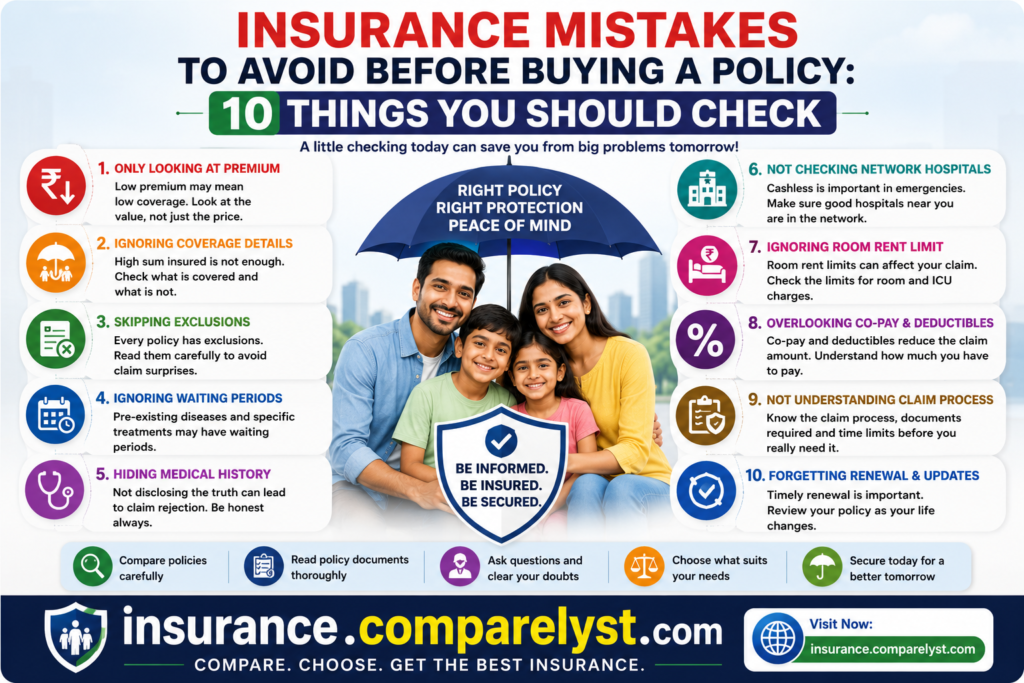
Insurance Mistakes to Avoid Before Buying a Policy: 10 Things You Should Check
When we decide to buy insurance, the first thing many of us look at is the premium amount. We often assume that a lower premium means a better policy. Sometimes, we might even decide to buy a policy simply because it offers ₹10 lakh in coverage.
However, the true details often become clear only after the purchase. You might discover a waiting period when trying to make a hospital claim, find that your preferred hospital isn’t in the network, or realize there are exclusions or co-payment clauses. Paying attention to these factors beforehand can significantly reduce future confusion.
When I first started learning about insurance, I also thought that simply choosing a policy from a reputed company was enough. But insurance isn’t a product you should choose based solely on the company’s name. What truly matters is the protection you need, what the policy covers (and what it doesn’t), and the conditions applicable at the time of a claim.
Therefore, it is crucial to avoid certain common mistakes before purchasing insurance.
In this article, let’s look at 10 important things to consider before buying an insurance policy—explained simply, just like a conversation between friends.
Mistake 1: Buying a Policy Solely Because the Premium is Low
“This policy costs only ₹8,000 a year, while the other one is ₹12,000. Let’s just go with the ₹8,000 one.”
Many of us make comparisons like this.
However, a low premium is not the sole indicator of a good insurance policy.
A policy might have a low premium but include restrictions like room-rent limits, co-payment clauses, sub-limits for specific treatments, long waiting periods, or important conditions listed under exclusions.
Another policy might have a slightly higher premium but offer coverage better suited to your needs and features that are comparatively more useful.
So, when buying insurance, before asking “How much is the premium?”, ask yourself, “What kind of protection am I getting for this premium?” It is advisable to ask.
Choosing a policy that results in higher out-of-pocket expenses at the time of a claim, just to save ₹3,000 or ₹5,000 on the premium, would not be a sound financial decision.
Compare premiums, but do not judge a policy based on the premium alone.
Second Mistake: Buying a policy based solely on the coverage amount
“I have ₹10 lakh insurance coverage, so I am safe.”
This statement sounds reassuring. However, having ₹10 lakh coverage does not automatically make a policy a good one.
A policy might offer a sum insured of ₹10 lakh, but how that amount is utilized is what truly matters.
Are there limits on room rent? Are there sub-limits for specific treatments? Is there a co-payment or deductible clause? How long is the waiting period? What are the exclusions?
These are all factors that can affect the actual claim amount.
Therefore, when purchasing insurance, do not focus only on the large figure; you must understand the actual terms and conditions of the coverage.
₹5 lakh might be sufficient for one person, while another might require ₹10 lakh or more. Requirements vary based on family size, age, location, existing health conditions, and financial situation.
Third Mistake: Not reading the policy exclusions
This is a very common mistake.
When buying an insurance policy, we often read only the benefits section. We feel happy seeing what is covered.
However, many people fail to read the section detailing what is *not* covered.
In reality, the exclusions section is crucial.
Certain treatments, conditions, or expenses may not be covered under a policy. Some expenses might not be payable based on the policy terms.
Therefore, it is advisable to read the exclusions thoroughly before purchasing a policy.
If there are terms you do not understand, seek clarification from the insurer or an authorized insurance intermediary.
Instead of assuming, “I have a policy, so all medical expenses will be covered,” it is far more useful to know exactly in which situations a claim would not be payable.
Fourth Mistake: Ignoring the Waiting Period
The waiting period is a crucial aspect of health insurance.
You might assume that coverage for all diseases begins immediately upon purchasing the policy. However, waiting periods may apply to certain treatments and pre-existing conditions.
For instance, if you have a specific medical condition prior to buying the policy, coverage for that condition might not be immediate; it could kick in only after a specified period.
Therefore, when purchasing a policy, ask not only “What is covered?” but also “When does the coverage begin?”
Simply looking for a policy with a short waiting period isn’t enough; you must also understand which conditions it applies to, the duration of the period, and the associated terms.
Being aware of this beforehand prevents disappointment—such as thinking, “I wasn’t aware of this”—when it comes time to file a claim.
Fifth Mistake: Concealing Medical History
You may be asked health-related questions when filling out an insurance application.
“I shouldn’t mention this old health issue; if I do, the premium might go up.”
“There’s no need to mention this minor treatment.”
Thinking this way is a mistake.
It is vital to provide truthful and complete medical information in the insurance proposal.
If you purchase a policy while concealing your medical history, questions regarding that information may arise during the future claims process, potentially leading to unnecessary complications.
Rather than hiding important information just to secure a slightly lower premium, it is better to provide accurate details from the start and fully understand the policy terms.
Instead of deciding on your own that you have “no health issues” and skipping information, the safer approach is to answer the questions in the proposal form accurately.
Sixth Mistake: Overlooking the Room Rent Limit
When buying health insurance, many people focus solely on the sum insured and disregard the room rent limit.
However, this can become significant during hospitalization.
A policy may stipulate a condition limiting the room rent to a specific amount per day.
If you choose a room that exceeds this limit, it could impact the claim calculation, depending on the policy terms. Some policies may include conditions such as proportionate deductions.
Therefore, before purchasing a policy, check if there are limits on room rent and ICU charges.
In my view, simply looking at “₹10 lakh coverage” while overlooking the room rent condition does not constitute a proper comparison.
Sometimes, the minor conditions of a policy matter more than the headline coverage amount.
Mistake #7: Not checking the list of cashless hospitals
An insurance company’s network might include thousands of hospitals.
That number might look impressive in advertisements.
But the question that matters most to you is different:
“Is there a good hospital near my home included in this network?”
That is the key question.
Check for hospitals near where you live. See if the hospital your family usually visits for treatment is part of the network.
If a cashless facility is available, the settlement process for eligible treatments—subject to policy terms and approval—takes place directly between the hospital and the insurer or TPA.
However, “cashless” does not mean that all expenses become zero.
The policyholder may still have to pay for non-covered expenses, applicable co-payments, deductibles, or amounts exceeding policy limits.
Therefore, do not choose a policy based solely on the fact that it offers a “cashless” facility.
Mistake 8: Not considering whether to choose individual policies or a floater policy for the family
Let’s assume a family consists of a husband, wife, and children.
They could take separate individual health insurance policies for everyone.
Or, they could opt for a family floater policy.
A family floater policy typically has a common sum insured, which eligible family members covered under the policy can utilize.
The advantage here is having a common pool of coverage for the family.
However, this isn’t necessarily the best option for every family.
If there is a significant age gap among family members—especially if there are older members—it is wise to compare both individual and floater options.
Instead of simply assuming that a single policy for everyone will result in a lower premium, you should consider the family’s actual health requirements.
Mistake 9: Buying a policy without understanding the claim process
Many people do not ask how to file a claim when purchasing insurance.
However, knowing the basic claim process before buying the policy is extremely useful.
When must the insurer or TPA be informed in the event of emergency hospitalization?
How do you obtain pre-authorization for cashless treatment?
What documents are required for a reimbursement claim? How important are documents like discharge summaries, bills, prescriptions, and diagnostic reports?
Being aware of these details beforehand helps minimize unnecessary confusion during an emergency.
After purchasing a policy, it is a good idea to save the policy document via email or in cloud storage. It is also practical to share details—such as the insurance company’s customer care number and your policy number—with your family members.
Simply buying an insurance policy is not enough.
You also need to know what steps to take when the time comes to file a claim.
Mistake 10: Deciding to buy a policy solely because “the agent recommended it,” without reading the policy document itself.
While it is certainly useful to have an insurance agent or advisor explain the policy to you—allowing you to gather details and clear up any doubts—it is best to read the policy document yourself before making a final decision.
This is because, rather than relying solely on a verbal explanation, it is crucial to understand the actual terms and conditions written in the policy.
Instead of relying on someone saying “this is covered,” check exactly how it is specified in the policy document.
Pay particular attention to details such as exclusions, waiting periods, co-payment, room-rent limits, deductibles, sub-limits, and renewal-related conditions.
If you come across technical terms you do not understand, ask for clarification.
Do not hesitate to ask questions when purchasing insurance.
Don’t buy a policy simply because “everyone else is buying it.”
Social media, YouTube videos, and advertisements might make a particular insurance policy appear very popular.
However, a popular product isn’t necessarily suitable for you.
A policy that works well for your friend might not provide the coverage *you* need.
Your age, family size, income, and medical requirements are different.
So, while you can use others’ experiences as a reference, your final decision should be based on your own specific needs.
Why is it important to compare policies before buying?
Even a single insurance company may offer multiple plans.
Coverage structures, premiums, and policy conditions can vary across different companies.
Therefore, instead of deciding based on the first policy you see, it is better to shortlist a few suitable options and compare them.
You can compare factors such as coverage amount, premium, waiting period, exclusions, room-rent limits, co-payment, deductibles, network hospitals, and the claim process.
Comparison platforms like insurance.comparelyst.com can serve as a helpful starting point in this process.
However, you shouldn’t buy a policy immediately just because it looks good on a comparison website.
Before making a final decision, it is crucial to verify the insurer’s official policy wording, the Customer Information Sheet, and the applicable terms and conditions.
Comparison helps in shortlisting options, but the final decision should be made only after fully understanding the policy documents.
Don’t put off buying insurance by saying, “I don’t have any problems right now.”
Many people think they don’t need health insurance when they are young.
- “I am healthy.”
- “I won’t need to go to the hospital.”
- “I can buy it in a couple of years.”
Postponing insurance purchases like this is common.
But no one knows what the future holds.
The purpose of insurance isn’t just to seek financial protection after a problem arises; it is about establishing financial protection *before* an unexpected situation occurs. Therefore, if you feel that health insurance is necessary for your financial situation, it is better to research the available options right away rather than constantly postponing the decision by saying, “I’ll look into it later.”
- Do not make this mistake after purchasing a policy.
- Do not assume your job is done just because you have bought the policy.
- Keep track of the policy renewal date.
- Keep your policy documents safe.
- Check that the nominee and family details are accurate.
- Review your policy coverage whenever your family situation changes.
In the event of marriage, the birth of children, relocation, or other major life changes, assess whether your existing insurance coverage still aligns with your current needs.
Insurance is not something you buy once and then forget about for a lifetime.
As your financial responsibilities change, your insurance requirements may also change.
A Real-Life Example
Let’s consider an example.
Suresh is 35 years old, married, and has two children.
He decides to buy health insurance.
Initially, he looks at a policy with a premium of ₹7,000 on a website.
He is immediately inclined to buy it.
However, after doing some research, he notices that the policy has restrictions on room rent. He checks the details regarding the waiting period and looks at the network of nearby hospitals.
The next policy has a premium of ₹10,000.
The premium is ₹3,000 higher.
But he realizes that the coverage structure, network hospitals, and policy terms are better suited to his needs.
What decision should he make now?
Instead of deciding, “The ₹7,000 policy is cheap, so I’ll buy that,” he should consider which policy is practically useful for his family.
The key lesson in this example isn’t the ₹3,000 difference in the premium.
What matters is making a decision after understanding the policy terms.
A Final Check Before Buying Insurance
Before purchasing a policy, first ask yourself, “Why am I buying this policy?”
Do you need protection against health expenses?
Do you need to cover family members?
Do your parents need separate coverage?
Do you already have insurance through your employer?
Is that coverage sufficient?
After that, look at the policy details:
Is the sum insured appropriate for your needs?
Is the premium manageable?
What is the waiting period?
How are pre-existing diseases handled?
Is there a room-rent limit?
Is there a co-payment clause?
Is there a deductible?
Are there sub-limits?
What are the major exclusions?
Are there network hospitals nearby?
How does the cashless process work?
What are the renewal terms?
What is the claim process?
If you choose a policy after getting clear answers to these questions, your decision will be well-informed.
Finally, my opinion…
Buying insurance can seem complicated. Insurance terminology can be particularly confusing for first-time buyers.
However, you do not need to be an insurance expert to choose a good policy.
You simply need to take the time to read the policy details patiently.
Do not buy a policy solely because the premium is low.
Do not buy a policy solely because the coverage amount is high.
Do not buy it just because an advertisement claims it is the “best policy.”
Do not buy it just because a friend uses it.
Do not buy it just because an agent recommended it.
Instead, first understand your own needs. Then, compare different options. Read the policy’s exclusions and limitations. Understand the waiting period and claim conditions. Accurately disclose your medical information.
Most importantly, buy insurance only after understanding not just “what I will get,” but also “what is not covered.”
The true value of insurance lies not in a low premium, but in the meaningful financial protection it provides when an unexpected situation arises.
A good insurance policy is not merely one with the most benefits.
A good policy is one that suits your specific needs.
So, the next time you buy insurance, do not rush your decision. Take the time to compare options, read the policy documents, and ask questions. That small effort can help you avoid significant financial confusion in the future.
Insurance Mistakes to Avoid Before Buying a Policy – FAQ
1. What should I look for first when buying insurance?
Instead of focusing solely on the premium, you should consider the purpose of the policy, the extent of coverage, exclusions, waiting periods, the claim process, and whether the policy suits your specific needs.
2. Is an insurance policy with a low premium a good choice?
Not necessarily. Even with a low premium, there may be conditions such as room-rent limits, co-payments, deductibles, exclusions, or waiting periods. Therefore, you should not choose a policy based on the premium alone.
3. What is the ‘Coverage Amount’ in insurance?
The coverage amount refers to the maximum sum insured or benefit amount provided by the insurer, subject to the policy terms. In health insurance, having a high coverage amount is not enough; you must also consider the associated limitations.
4. Why is the ‘Waiting Period’ important when buying health insurance?
Coverage for certain diseases, treatments, or pre-existing conditions may not be available immediately after the policy starts. A waiting period is the time one must wait before coverage for these conditions kicks in. Therefore, you should check the waiting period details before purchasing the policy.
5. Should I disclose pre-existing diseases to the insurance company?
Yes. It is crucial to accurately disclose information regarding your medical history and existing health conditions in the proposal form. Withholding information could lead to complications during the future claim process.
6. What are ‘Exclusions’?
Exclusions refer to treatments, medical conditions, or expenses that are not covered by the policy. It is very important to read the exclusions section before buying the policy.
7. What is the ‘Room Rent Limit’?
The policy may specify a limit on room rent charges during hospitalization. If you choose a room that exceeds this limit, the claim calculation may be affected, depending on the policy terms.
8. What is ‘Co-payment’?
Co-payment is a condition where the policyholder is required to pay a specific portion of the eligible claim amount. When buying a policy, you should check the co-payment amount and the situations under which it applies.
9. What is a ‘Deductible’? A ‘deductible’ is a structure where the policyholder is required to bear a specific portion of the claim amount initially. It is advisable to evaluate both the premium and potential out-of-pocket expenses incurred at the time of a claim.
10. What is a ‘Cashless Hospital’?
A ‘cashless facility’ refers to an arrangement where, upon receiving eligible treatment at a hospital within the insurance company’s or TPA’s network, the claim settlement is handled directly between the insurer/TPA and the hospital, subject to policy terms and approval.
Important Note
This article is written for general educational and informational purposes only. Aspects such as premiums, eligibility, coverage, exclusions, waiting periods, co-payments, deductibles, claim procedures, and other terms may vary depending on the insurer and the specific product. Before purchasing any insurance policy, please carefully read the official policy wording, Customer Information Sheet, and applicable terms and conditions provided by the insurer.
This does not constitute personal insurance, financial, or medical advice. You may seek advice from an authorized insurer, licensed insurance intermediary, or qualified professional to choose the policy and coverage that best suit your needs.
- Financial Disclaimer: The information provided on this website is for general informational and educational purposes only. It should not be considered financial, investment, lending, legal, or professional advice. Readers should evaluate their own financial situation and consult a qualified financial professional before making financial decisions.
- Your Money, Your Decision, Your Risk: Loan products, interest rates, fees, eligibility requirements, and terms may vary by lender and may change without notice. Please verify all information directly with the relevant lender before applying for or accepting a financial product.
- Loan comparison disclaimer: Loan comparisons are provided for informational purposes. The availability, interest rate, processing fees, tenure, eligibility criteria, and other terms may differ depending on the lender, applicant profile, location, credit history, and other factors.
- Rates can change: Interest rates, fees, loan amounts, repayment terms, eligibility requirements, and other product details can change. Always confirm the latest terms and conditions with the lender before making a decision.
- No guarantee of approval: Inclusion of a lender or loan product on this website does not guarantee loan approval. Final approval, interest rate, loan amount, and terms are determined by the respective lender based on its own eligibility and underwriting criteria.